

End-of-Year Fashion Inventory Auditing: A Guide for UK Apparel Brands
Ask any UK studio manager or production coordinator about their least favourite day on the calendar, and they will rarely point to London Fashion Week prep or late-night fit sessions. They’ll point to the dreaded annual stock take. It is traditionally the day everyone in the studio catches a phantom cold to avoid spending twelve hours in a freezing warehouse, clipboard in hand, attempting to decipher handwritten bin numbers and count half-empty boxes of horn buttons.
Yet in today’s market, accurate stocktaking and stock management are no longer just administrative chores for the finance team. With shifting consumer demand, strict UK warehouse compliance, and the tightening net of sustainability directives like UK Textiles Extended Producer Responsibility (EPR) and EU Digital Product Passports (DPP), an end-of-year audit is the operational backbone of a profitable business.
If you are closing out the fourth quarter on a patchwork of disconnected spreadsheets, an audit often feels like post-mortem damage control. Approached with the right systems, an end-of-year review becomes your sharpest commercial lever for future range planning.
Here is how modern UK apparel brands replace manual spreadsheet panic with quiet confidence, synchronising physical counts with digital reality.

The Cost of Frozen Capital
For years, the apparel industry operated on a “just-in-case” buffer: ordering extra rolls of cashmere, overproducing bestselling silk blouses, or holding surplus boutique stock across multiple channels. The fallout of this buffer sits on your balance sheet as dead stock.
Every unsold garment or unallocated metre of fabric represents frozen working capital. When inventory sits unmonitored:
- Holding costs compound: Warehouse shelf fees and third-party logistics (3PL) storage rates quietly erode your gross margin.
- Raw materials spoil: Rolls of deadstock lace and bespoke trims become obsolete as collections turn over.
- Retail integrity dilutes: Excessive overstock inevitably ends in steep post-holiday discounting, slashing the value of your hero lines.
A rigorous end-of-year audit forces a transition from “just-in-case” clutter to a lean, “just-in-time” approach. Accurate counts allow you to release locked capital and direct funds where they belong: into innovative fabric sourcing, production runs, or your next campaign.
Unify Raw Materials and Finished Stock
Most generic inventory systems treat an apparel brand like a hardware merchant, assuming a “unit” is a static, standalone box. Fashion operations require tracking both sides of the production coin: raw materials (metres of fabric, lining, bespoke zips, and pocket bags) and finished goods across a multi-dimensional style-colour-size matrix.
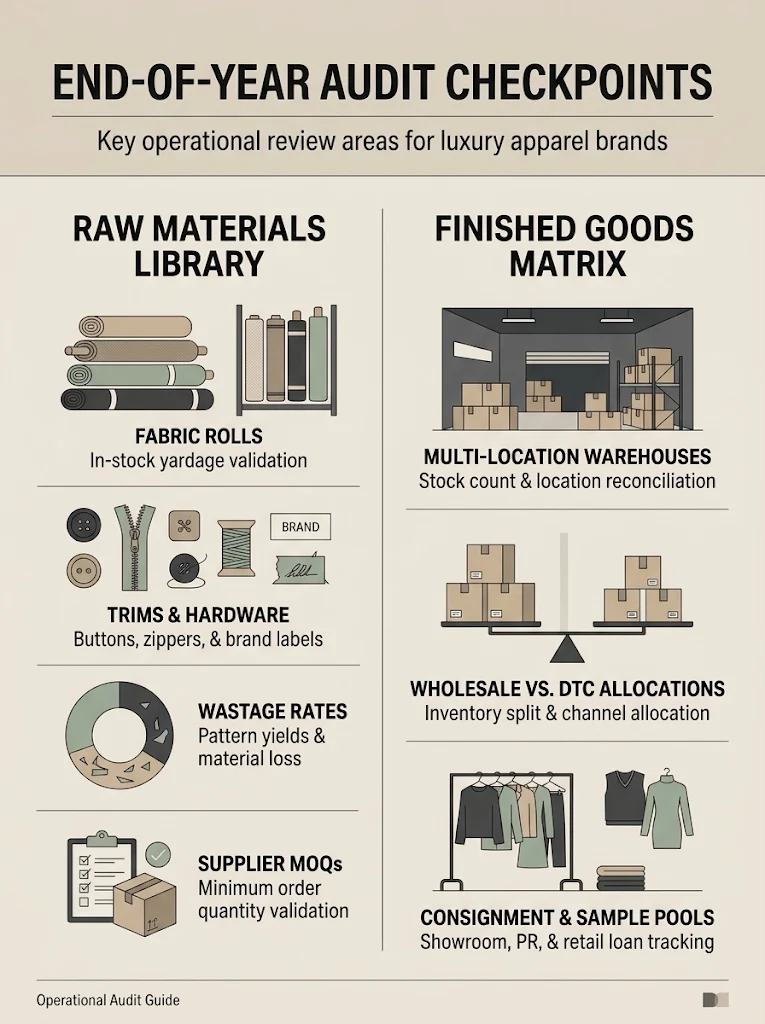
A common failure during seasonal stocktakes is auditing only the finished garments hung on rails while neglecting the raw material store.
Connecting your digital Bill of Materials (BOM) in Z.Studio directly to live purchase orders in Z.Hub allows you to audit actual fabric consumption against projected yields. Knowing your exact fabric yardage and hardware reserves prevents over-ordering raw materials you already have in your storage hub.
Bridge the Gap Between Buying, Merchandising, and the Warehouse Floor
Precision fashion buying and merchandising depends entirely on the accuracy of your stock baseline. When stock levels are out of sync across your e-commerce storefront, physical boutiques, and wholesale accounts, merchandisers must plan upcoming seasons based on guesswork.
Connecting your warehouse operations to an integrated fashion inventory management platform keeps your commercial pillars perfectly aligned:
Identify Popular Styles vs Underperformers
High-level sales turnover figures can mask underlying variant discrepancies. An end-of-year audit reveals which specific sizes, cuts, or colourways had slow sell-through rates, pinpointing where excess markdown liability occurred. Merchandising teams can refine seasonal buys and size curves for the upcoming Autumn/Winter collection, purchasing fewer outlier sizes and backing confirmed popular styles.
Synchronise Multi-Channel Stock Allocations
If your label balances direct-to-consumer (DTC) sales via Shopify alongside wholesale accounts with Selfridges, Harrods, or global stockists, channel friction is an ever-present risk. A sudden influx of holiday online orders cannot deplete stock reserved for forward wholesale deliveries. Unified stock allocation rules protect high-priority retail agreements while keeping live stock availability synchronised across every customer touchpoint.
Replacing Paper with Automated Accuracy
Manual stock counting is the primary source of inventory discrepancies. A coordinator notes down “12 units” on a clipboard; two days later, an administrator keys it into a master spreadsheet as “21,” and an entire line is miscounted.
Forward-thinking British labels handle the audit process with structured digital workflows:
1. Leverage Barcode Scanning: Move away from paper count sheets. Barcode-driven scanning tools sync directly with your inventory database, validating physical units against product master records in real time.
2. Audit Virtual Locations: Modern fashion stock lives in more places than just your central distribution centre. Make sure your count encompasses sample collections out with PR agencies, lookbook styling sets, consignment garments held in partner showrooms, and stock in transit between international warehouses.
3. Establish a Routine Cycle Count: Year-end auditing should not be a frantic 48-hour scramble. Establishing periodic cycle counts, checking small, rotating batches of SKUs throughout the season, turns the annual audit into a final verification rather than a major disruption.
Navigating UK Compliance: DPP and EPR Readiness
For UK apparel brands operating post-Brexit, stock management now extends beyond domestic boundaries. The EU’s Ecodesign for Sustainable Products Regulation (ESPR) means any British label exporting collections into the European Union will soon need an EU Digital Product Passport (DPP) for every garment, detailing raw material origins, chemical components, and recyclability pathways.
At the same time, the UK government is advancing its own Textiles Extended Producer Responsibility (EPR) regulations, holding brands accountable for post-consumer waste through eco-fee modulation. Under EPR, brands that lack clear data on material weights, fibre compositions, and total volumes placed on the market face substantial penalties.
An end-of-year audit is the natural moment to review your product data integrity. When your style libraries, Bills of Materials, and supplier compliance certificates are centralised within an open-API ecosystem, extracting the reports needed for EPR declarations and DPP QR code generation shifts from a stressful compliance scramble to a streamlined, automated workflow.
Master Your Stock Management with Zedonk
An end-of-year audit should not leave your team exhausted and buried under paperwork. It should provide the clarity needed to protect your retail margins, streamline factory purchase orders, and scale your brand with full operational confidence.
Born in London and backed by fashion industry veterans, Zedonk provides independent labels, luxury houses, and wholesale showrooms with a specialist, fashion-first ERP and PLM platform. By uniting tech pack development, production scheduling, multi-location stock tracking, and B2B wholesale order entry under one roof, Zedonk turns inventory chaos into a distinct competitive advantage.
Ready to simplify your studio operations and take the stress out of your stock management? Book a free demo with the Zedonk UK team today.