How ERP Helps Small Fashion Labels Compete Online
Selling online can look deceptively simple. Launch a website, connect your sales channels, post regularly, and wait for orders to come in. In reality, growth creates pressure quickly, especially for smaller fashion labels managing tight stock levels, seasonal drops, supplier lead times, and customers who expect fast, accurate delivery. That is where an starts to matter.
An ERP for small businesses is not about adding complexity or copying the systems used by global corporations. It is about bringing the moving parts of the business into one place, so you can see what is selling, what needs reordering, what is delayed, what is already allocated, and what your team needs to do next. For online fashion brands, that visibility often separates controlled growth from constant firefighting.

Online growth creates operational problems fast
Small labels often begin with workarounds. A spreadsheet tracks stock. Emails handle supplier updates. Orders come in from the website, a showroom, or a wholesale customer, and someone manually checks what is available. That can work for a while, but the trouble starts when sales pick up.
A strong promotion, a seasonal launch, or an unexpected e-commerce spike can throw projections off overnight. Suddenly, the same item is being sold across more than one channel, stock figures are lagging behind, and the team is trying to piece together the real picture after the fact. That is one of the biggest reasons fashion businesses begin looking at ERP for small businesses. They do not just need more data; they need live information they can trust while decisions are being made.
Why fashion labels need more than basic stock tracking
Supply Chain Management (SCM) is the organisation of every step in a product’s supply chain. The supply chain includes any processes that are carried out until the product reaches its final customer. In fashion, this includes initial procurement, operations, and logistics.
Better visibility across every sales channel
One of the hardest parts of selling online is keeping a clear view across channels. A label might be trading through its own website, taking wholesale orders, running pop-ups, or using a digital showroom alongside direct-to-consumer sales. When those channels are not connected, the same stock can appear available in more than one place at once.
An ERP for small businesses helps solve that by giving your team one shared source of visibility. Instead of chasing updates between systems, you can see open orders, available inventory, allocations and fulfilment status in real time.
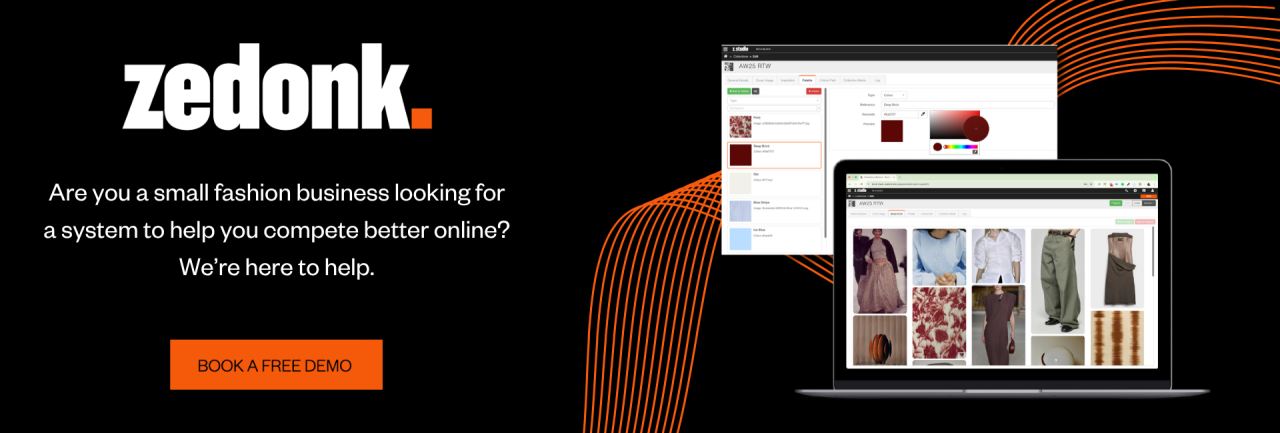
Zedonk is built specifically for fashion businesses. Its tools connect product development, inventory, order management, fulfilment, and B2B sales, so smaller brands can work from one operational picture rather than several partial ones.

Stock control works best when your warehouse is connected
Good stock control does not end with the software. It also depends on where your products are physically stored and how smoothly that setup connects back to the system.
For some small labels, that means an organised in-house stockroom. For others, it means a warehouse partner or third-party logistics provider. Either way, your ERP should reflect what is really happening on the ground.
When warehouse activity and ERP data stay in sync, it becomes easier to manage goods in transit, inbound deliveries, picked orders, shipped quantities, and current stock positions. Zedonk supports this through stock allocation, fulfilment tools, and integrations with warehouse and logistics systems, helping brands keep control as order volume grows.
That connection is especially valuable after online spikes. If a campaign performs better than expected, you need to know quickly what can still be sold, what should be held back, and what needs urgent action.
A cloud-based ERP for small business teams keeps things practical
Smaller brands do not need bloated systems that take months to understand. They need something usable, accessible, and scalable.
That is why a cloud-based ERP for small businesses can be such a strong fit. Teams can access the system from different locations, work from the same live data, and avoid the version-control problems that come with sending spreadsheets back and forth.
Cloud systems also make growth easier to manage. You can start with the functions you need most, then expand as the business becomes more complex. Zedonk’s modular approach reflects that reality well, allowing brands to strengthen stock control first and add deeper production, fulfilment, or digital showroom capability later.
More control, less admin
A common misconception is that ERP creates more processes than a small business really needs. In practice, the right system reduces manual checking, duplicated input, and avoidable admin.
Instead of spending time reconciling stock numbers, chasing order updates, or rebuilding reports manually, teams can focus on trading, customer relationships, product planning, and growth. The right ERP also improves confidence by replacing yesterday’s spreadsheet with a live overview of products, orders, deliveries, and stock movement.
A stronger base for sustainable growth
Competing online is not just about being visible to customers. It is also about being ready when demand arrives.
For small fashion labels, that means having a system that supports accurate inventory, smoother order handling, better fulfilment, and clearer multi-channel visibility without making everyday work harder. That is where ERP earns its place.
If you are comparing the best ERP system for small businesses, it helps to look beyond generic software and focus on systems built for the realities of fashion. Zedonk is designed around those realities, from product and stock management through to fulfilment, wholesale ordering, and connected workflows across the business.
Reach out to us if you want your small fashion brand to stay organised, respond faster, and scale online with more confidence.